Africa Tech Insights
Insights into Africa's Tech Evolution
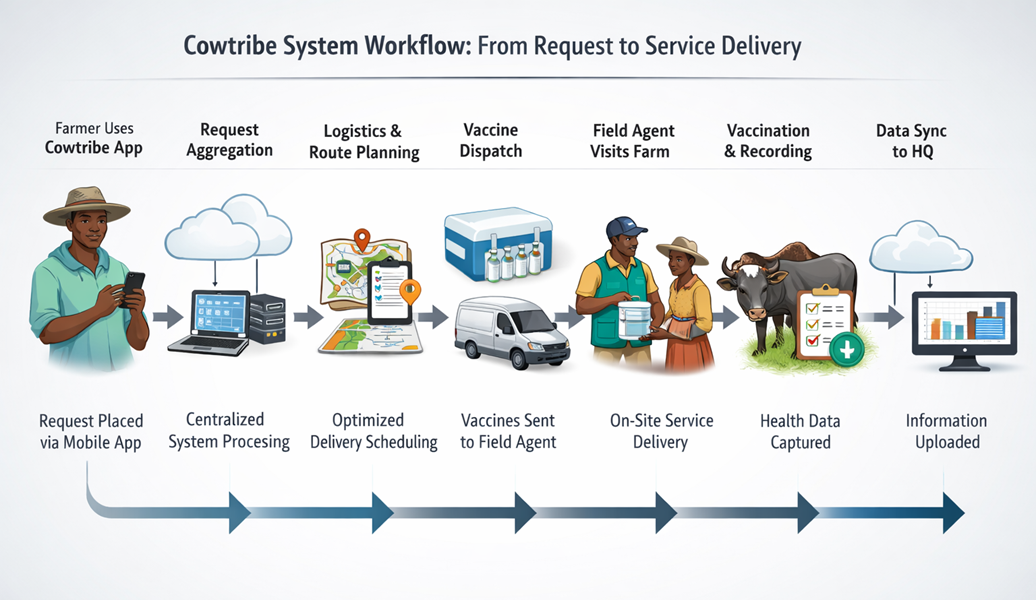 Image Credit: Image generated using AI for illustrative purposes.
Cowtribe: Digitized Veterinary Supply Chain and Livestock Health Delivery Network in Africa
Overview
Cowtribe is an innovative startup aimed at revolutionizing the veterinary supply chain and livestock health delivery network in Africa. By leveraging technology, Cowtribe addresses the challenges faced by livestock farmers, particularly in rural areas, where access to veterinary services and essential supplies is often limited. The platform connects farmers with veterinary professionals, creating a seamless supply chain that ensures timely delivery of veterinary products and services. This initiative not only aims to improve livestock health but also to enhance food security and the livelihoods of farmers across the continent. Cowtribe's unique approach positions it as a critical player in the agritech sector, fostering sustainable agricultural practices in Africa.
💡 Idea
The core idea of Cowtribe is to create a digitized platform that serves as a one-stop solution for livestock health management and veterinary supply. The platform enables farmers to access veterinary services, health consultations, and purchase essential veterinary supplies online, thereby eliminating geographical barriers. By integrating a mobile application with a network of veterinary professionals and suppliers, Cowtribe empowers farmers to make informed decisions regarding their livestock's health. Additionally, the platform collects data on livestock health trends, which can be utilized for research and policy-making. The concept is built on the premise that improved access to veterinary care will lead to healthier livestock, increased productivity, and ultimately, improved economic outcomes for farmers.
⚙️Cowtribe: How It Works
Cowtribe operates through a user-friendly mobile application that allows farmers to register and input information about their livestock. Once registered, farmers can schedule consultations with veterinarians directly through the app, providing them with immediate access to professional advice. The app also features a marketplace where users can purchase veterinary supplies such as vaccines, medications, and feed. Upon ordering, the platform coordinates the logistics for delivery, ensuring that products reach the farmers in a timely manner. Furthermore, Cowtribe integrates a feedback system that allows farmers to rate their experiences with veterinarians and products, fostering a community of trust and quality assurance. The use of telemedicine features enables veterinarians to provide remote diagnostics and treatment plans, which is particularly beneficial in areas with limited access to healthcare facilities.
🚀 Why It’s Amazing
Cowtribe is remarkable for its holistic approach to addressing the challenges of livestock health in Africa. By digitizing the veterinary supply chain, it not only improves access to essential services but also enhances the efficiency of veterinary professionals. The platform promotes a data-driven approach to livestock management, allowing for better tracking of health trends and more targeted interventions. This innovative model has the potential to significantly reduce livestock mortality rates, increase productivity, and consequently improve food security in the region. Additionally, Cowtribe encourages local entrepreneurship by creating opportunities for veterinary professionals and suppliers, fostering economic growth within the community. By bridging the gap between technology and agriculture, Cowtribe exemplifies how digital solutions can transform traditional industries in developing countries.
💻 Technical Analysis
From a technical perspective, Cowtribe's architecture is designed to be scalable and resilient. The frontend is primarily a mobile application built using React Native, allowing for cross-platform compatibility on both Android and iOS devices. This ensures a wider reach among farmers who may have access to different mobile devices. The backend is powered by a robust API built using Node.js and Express, which facilitates smooth communication between the frontend and the database. For data storage, a cloud-based database solution such as MongoDB is utilized, ensuring data persistence and scalability as the user base grows. The system implements a microservices architecture, where different services handle specific functionalities such as user authentication, order processing, and veterinary consultations. This modular approach allows for easier updates and maintenance while ensuring high availability. Additionally, leveraging cloud services enhances the application's scalability, enabling it to handle increased traffic during peak usage times.
🧱 System Architecture
Cowtribe's architecture comprises several key components that work in harmony to provide a seamless user experience. The frontend consists of a mobile application that serves as the primary user interface, allowing farmers to interact with the platform easily. The application communicates with the backend through RESTful APIs, which are responsible for processing user requests and retrieving data. The backend architecture includes several microservices, each dedicated to specific tasks such as user management, product inventory, order fulfillment, and veterinary consultations. The data layer utilizes a NoSQL database to manage the diverse and dynamic data generated by users, such as livestock health records and transaction histories. Furthermore, the system incorporates a caching mechanism to enhance performance by reducing latency for frequently accessed data. Security measures are implemented through user authentication protocols and data encryption, ensuring that sensitive information remains protected. Overall, the architecture is designed to be modular, scalable, and secure, supporting the growth of the platform as it expands its reach across Africa.
🧭 Cowtribe: Platform Walkthrough
- Step 1: User Registration - Farmers download the Cowtribe mobile application and create an account, providing necessary information about themselves and their livestock.,
- Step 2: Livestock Profile Creation - Users input details about their livestock, including species, health history, and vaccination records, creating a comprehensive health profile.,
- Step 3: Accessing Veterinary Services - Farmers can browse available veterinary professionals and schedule consultations either in-person or via telemedicine through the app.,
- Step 4: Ordering Veterinary Supplies - Users can browse a marketplace of veterinary products, select needed items, and place orders directly through the app.,
- Step 5: Delivery Coordination - Once an order is placed, the platform coordinates with logistics partners to ensure timely delivery of the products to the farmer's location.,
- Step 6: Feedback and Rating - After receiving services or products, farmers can rate their experiences, providing valuable feedback that enhances the quality of services offered.,
- Step 7: Data Analytics - Cowtribe collects and analyzes data from user interactions to identify health trends, improving future services and informing agricultural practices.,
- Step 8: Continuous Improvement - Based on user feedback and data analytics, the platform iterates on its offerings, ensuring it remains relevant and effective in addressing farmers' needs.
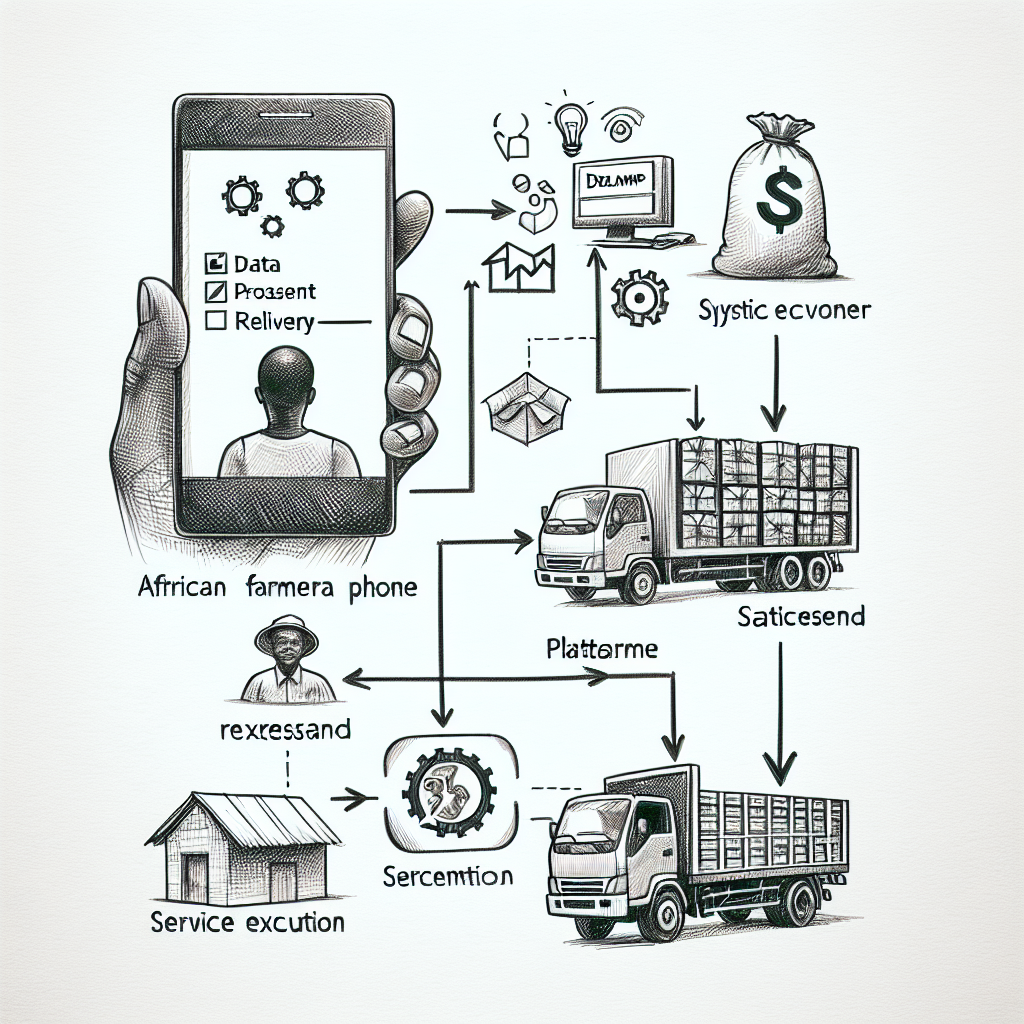 AI-generated system flow sketch
The content above is generated by an AI system using prompt-based instructions defined during development of this platform. It is designed to assist in understanding the topic by providing structured and automated insights. Users are encouraged to interpret the information as supplementary guidance.
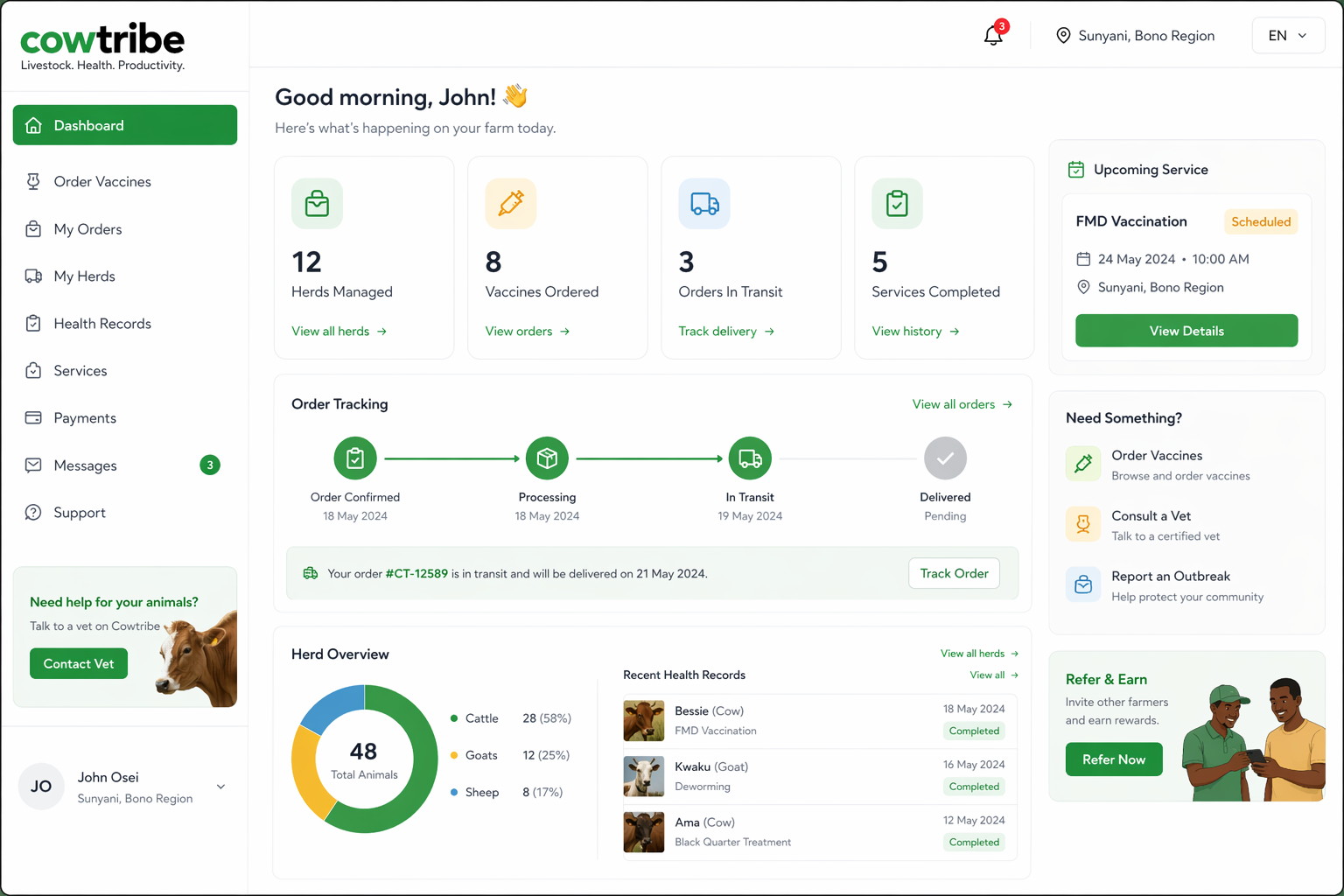 Image Credit: Illustrative AI-generated image. The actual app design may differ.

April 19, 2026 | 800 words | 4 min read
Cowtribe is not a conventional livestock application; it operates as a distributed veterinary supply chain orchestration platform that digitizes vaccine distribution, livestock healthcare coordination, and last-mile delivery logistics across rural African environments.
Detailed Analysis
CORE PRODUCTS | PLATFORM LAYERS
At the foundational layer, the system functions as a demand aggregation engine, where smallholder farmers’ livestock health requirements are captured through mobile interfaces and consolidated into structured demand clusters. This eliminates fragmentation in rural veterinary supply chains and enables predictive stock planning.
The second layer is the logistics orchestration layer, which coordinates vaccine distribution through certified agrovet agents and partner veterinary professionals. This layer integrates routing, scheduling, and fulfillment workflows, effectively functioning as a last-mile delivery optimization system.
The third layer is the health service execution layer, where actual veterinary interventions occur—vaccination, medication delivery, and livestock treatment. This layer represents the physical execution bridge between digital request systems and real-world agricultural operations.
The final layer is the data intelligence layer, where transaction data, livestock health records, and service interactions are aggregated. This creates a longitudinal dataset capable of supporting predictive analytics for disease outbreaks, vaccination coverage gaps, and supply chain inefficiencies.
CONCEPTUAL STRENGTH (WHY IT WORKS)
Cowtribe succeeds because it restructures a fundamentally informal and fragmented veterinary ecosystem into a digitally coordinated supply chain network.
The core conceptual advantage lies in demand aggregation under constrained rural infrastructure. Instead of attempting to increase supply density (which is economically inefficient in rural Africa), Cowtribe reduces operational inefficiency by consolidating demand signals into predictable clusters.
Another critical strength is its trust abstraction model. Rural livestock markets are heavily influenced by informal agrovet vendors, often with inconsistent service quality. Cowtribe replaces this uncertainty with a certified provider network, effectively introducing verification layers into an otherwise unregulated system.
The platform also operates on a subscription + event-based service model, which shifts livestock healthcare from reactive, crisis-driven interventions to preventive and scheduled care cycles. This fundamentally improves livestock survival rates and reduces systemic risk.
From an architectural standpoint, the system is resilient because it assumes:
∘intermittent connectivity
∘low digital literacy
∘decentralized service execution
It therefore prioritizes operational reliability over computational complexity.
SOFTWARE & TECHNOLOGY STACK (INFERRED)
Cowtribe’s architecture can be inferred as a hybrid logistics + health-tech distributed system optimized for low-bandwidth environments.
The client layer consists of mobile applications (Android-first) used by farmers, agrovet agents, and field coordinators. These clients are optimized for lightweight interactions such as order placement, service confirmation, and notification handling.
The backend layer is likely built on RESTful APIs using frameworks such as Laravel or Node.js, responsible for:
📌Order aggregation
📌Service scheduling
📌Inventory tracking
📌User management
The logistics layer integrates third-party systems such as drone delivery networks (e.g., Zipline partnerships) and distributed agrovet fulfillment nodes, introducing a real-world API abstraction layer over physical logistics infrastructure.
The data layer is structured using relational databases (MySQL/PostgreSQL) for transactional integrity, with potential use of analytics pipelines for aggregating livestock health trends and service performance metrics.
The system also incorporates:
✔️SMS-based fallback communication channels
✔️Push notification systems (Firebase Cloud Messaging)
✔️Geospatial coordination modules for delivery routing
Architecturally, Cowtribe behaves as a supply chain-as-a-service platform with embedded data analytics capabilities, rather than a traditional agricultural app.
The system is essentially an AI pipeline:
Although not fully AI-driven in execution, Cowtribe functions as a data accumulation and decision-support pipeline that is structurally compatible with AI systems.
The pipeline begins with field-level data ingestion, where livestock health needs are captured and converted into structured service requests. This is followed by aggregation and normalization, where fragmented demand is consolidated into regionally optimized supply plans.
Next is the logistics inference layer, where routing, scheduling, and delivery decisions are executed based on demand clusters and resource availability. This layer behaves like a rule-based optimization engine.
Finally, the system generates a longitudinal dataset of livestock health interventions, which can be used for predictive modeling such as:
∘Outbreak forecasting
∘Vaccine demand prediction
∘livestock mortality risk modeling
∘Supply chain optimization algorithms
In essence, Cowtribe is an AI-ready agricultural logistics dataset generator, even if its current implementation is not fully machine learning–driven.
WHY THIS IS CRUCIAL AND REVOLUTIONARY FOR AFRICA
Cowtribe is strategically significant because it directly addresses one of Africa’s most persistent structural inefficiencies: fragmented agricultural input distribution systems combined with high livestock disease mortality rates. By digitizing vaccine distribution and veterinary service coordination, the platform introduces predictability into an otherwise highly stochastic rural supply chain environment.
This has several systemic impacts:
- First, it reduces livestock mortality by ensuring timely and consistent vaccine availability, directly improving food security and rural income stability.
- Second, it formalizes previously informal agrovet markets, introducing traceability, accountability, and quality assurance mechanisms into veterinary service delivery.
- Third, it enables the emergence of data-driven agricultural policy frameworks, as aggregated livestock health data becomes available for national planning and
disease control strategies.
- Most importantly, Cowtribe represents a shift from fragmented veterinary service delivery to a networked, platform-based agricultural infrastructure model, which
is foundational for scaling modern agritech systems across Africa.

Global Platforms Similar to Cowtribe
Across the world, a growing number of digital platforms are addressing the same challenges that Cowtribe targets—inefficiencies in livestock management, limited access to veterinary services, and fragmented agricultural supply chains. These platforms use mobile technology, data analytics, and cloud-based systems to help farmers track animal health, manage herds, access veterinary support, and improve productivity. While many originated in more developed agricultural markets, their core ideas—digitizing livestock records, streamlining service delivery, and connecting farmers to broader ecosystems—are highly relevant globally. What distinguishes Cowtribe is its adaptation of these concepts to African conditions, where infrastructure gaps, smaller-scale farming, and last-mile service delivery require more localized, flexible, and agent-driven solutions.
Cattle Care, AgriWebb, Stellapps, FarmWizard
Ahmed is an opinion writer with a keen interest in African technology. He is a full-stack software developer based in Seattle.
