Africa Tech Insights
Insights into Africa's Tech Evolution
Insights
Ethiopia Survives — And More Is Yet to Come.
 By Staff Writer |
Estimated Reading Time: 4 min |
Total Words:
784 |
Published: 20 February 2026
| 13 views
By Staff Writer |
Estimated Reading Time: 4 min |
Total Words:
784 |
Published: 20 February 2026
| 13 views
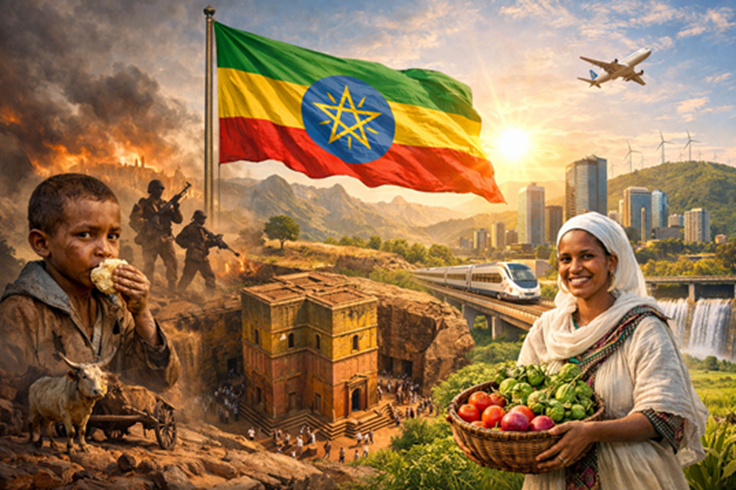
Image Credit: DELLE
A Nation Built on Resilience
Few countries in Africa symbolize endurance and continuity like Ethiopia. With a recorded history stretching back thousands of years, Ethiopia has repeatedly faced adversity — from colonial threats and famine to political upheavals and economic pressures — yet it continues to stand firm.
Unlike many African nations, Ethiopia maintained its sovereignty during the colonial era, becoming a symbol of independence across the continent. That historical legacy still shapes national identity today. Survival, for Ethiopia, has never meant merely existing; it has meant adapting, rebuilding, and moving forward.
Over the past decades, the country has endured internal conflicts, climate challenges, and economic strain. Yet its population — now exceeding 120 million — remains young, energetic, and deeply entrepreneurial. Markets remain vibrant, agriculture continues to feed millions, and cities grow despite uncertainty.
Economic Transformation in Motion
Ethiopia’s survival story is also an economic one. For years, the country pursued a state-led development model focused on infrastructure, manufacturing, and agriculture. Massive investments in roads, railways, industrial parks, and energy projects have begun reshaping the national economy.
The capital city, Addis Ababa, stands as the centerpiece of this transformation. High-rise buildings, modern transit systems, and expanding business districts reflect a nation attempting to leap into the future.
Industrialization has become a key pillar of Ethiopia’s strategy. Textile factories, agro-processing industries, and export-focused manufacturing zones aim to create employment and reduce dependence on raw agricultural exports. While challenges remain — including inflation and foreign currency shortages — long-term growth ambitions remain intact.
Energy development also plays a significant role. Hydropower investments promise to make Ethiopia one of Africa’s largest electricity producers, enabling industrial expansion and regional power exports.
Agriculture: The Backbone of Survival
Despite rapid modernization, agriculture continues to define Ethiopian life. Millions rely on farming for income and food security. Coffee, the country’s most famous export, connects rural farmers to global markets while preserving cultural heritage.
Climate variability and droughts have tested rural communities, but farmers increasingly adopt irrigation, improved seeds, and cooperative models. International partnerships and domestic reforms aim to strengthen food resilience and reduce vulnerability to future shocks.
Agriculture represents more than economic activity; it is a symbol of national continuity — proof that even in difficult times, Ethiopia feeds itself and sustains its traditions.
Urban Growth and Youth Innovation
Ethiopia’s young population is reshaping society. Technology startups, digital payment platforms, and innovation hubs are emerging in urban centers. Universities are producing engineers, developers, and entrepreneurs eager to participate in the global digital economy.
Internet expansion and telecom reforms have opened new opportunities for investment and competition. Ethiopian youth increasingly view technology as a pathway toward employment and global engagement.
Creative industries — music, film, fashion, and media — are also gaining international attention, helping redefine Ethiopia’s global image beyond crisis narratives.
Ethiopian Airlines: Africa’s Aviation Success Story
No discussion of Ethiopia’s rise is complete without highlighting Ethiopian Airlines, widely regarded as Africa’s most successful airline.
Founded in 1945, Ethiopian Airlines has grown into one of the world’s fastest-expanding aviation networks. Operating from its hub in Addis Ababa, the airline connects Africa to Europe, Asia, the Middle East, and the Americas, making Ethiopia a critical global transit gateway.
Unlike many state-owned carriers that struggle financially, Ethiopian Airlines has consistently remained profitable. Its success comes from long-term planning, professional management, fleet modernization, and investment in aviation training academies.
The airline also plays a strategic national role. It supports tourism, trade, cargo logistics, and diplomatic connectivity across Africa. During global crises — including the COVID-19 pandemic — Ethiopian Airlines became a major cargo lifeline, transporting medical supplies worldwide.
Beyond aviation, the airline symbolizes Ethiopian ambition: disciplined growth, regional leadership, and confidence in competing on a global stage.
Challenges That Still Remain
Ethiopia’s journey is far from complete. Political tensions, regional conflicts, economic reforms, and humanitarian needs continue to test national unity and stability. Inflation, unemployment, and climate risks remain serious concerns.
Yet history suggests that Ethiopia’s strength lies in resilience. The nation has repeatedly demonstrated the ability to endure hardship while preserving its cultural identity and long-term vision.
International partners increasingly recognize Ethiopia’s strategic importance — not only as a large market but as a diplomatic and economic anchor in the Horn of Africa.
More to Come
Ethiopia’s story is not simply about survival; it is about transformation. From ancient civilization to emerging economic power, the country stands at a crossroads between past struggles and future opportunity.
If infrastructure expansion continues, political stability strengthens, and youth innovation accelerates, Ethiopia could become one of Africa’s defining success stories of the 21st century.
The message emerging from Ethiopia today is clear: the nation has survived — and its next chapter may be even more remarkable.
This is an opinion piece. The views expressed in this article are those of just the author.
