Africa Tech Insights
Insights into Africa's Tech Evolution
Op-Ed
Skyward Africa: How Cloud Computing Is Powering the Continent’s Digital Leap
Cloud computing is rapidly transforming Africa’s technological landscape by reducing infrastructure barriers, enabling startups to scale faster, and democratizing access to advanced digital tools. As connectivity improves and data centers expand across the continent, the cloud is becoming the backbone of Africa’s next wave of innovation, entrepreneurship, and economic growth.
 By Ismail Mohamed |
Estimated Reading Time: 4 min |
Total Words:
737 |
Published: 10 March 2026
| 173 views
By Ismail Mohamed |
Estimated Reading Time: 4 min |
Total Words:
737 |
Published: 10 March 2026
| 173 views
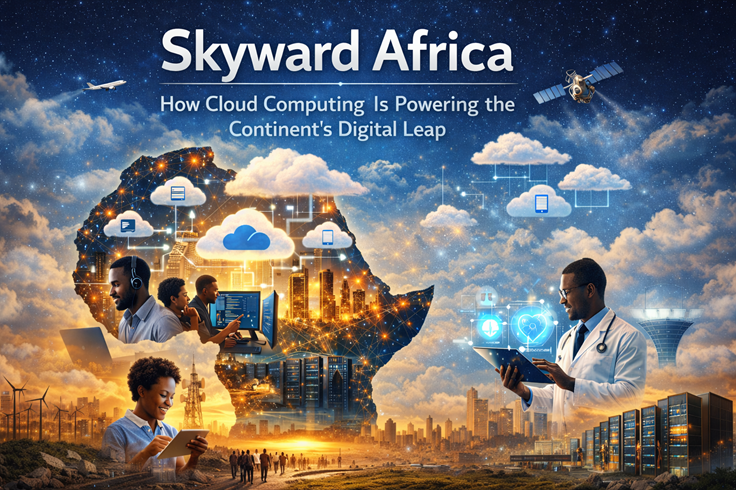
Image Credit: Image Credit: Image generated using AI for illustrative purposes.
1. Breaking Infrastructure Barriers
For decades, one of the biggest obstacles to technological growth in Africa has been infrastructure. Building and maintaining traditional IT systems requires significant investment in servers, data centers, networking hardware, and skilled personnel. For many African startups and institutions, these costs were simply too high.
Cloud computing is changing this equation entirely.
Instead of purchasing expensive hardware, businesses can now rent computing power, storage, and software over the internet. This pay-as-you-go model dramatically lowers the barrier to entry for entrepreneurs and small companies. A startup in Nairobi, Lagos, or Kigali can launch a global digital platform with minimal upfront cost.
Major global cloud providers like Amazon Web Services, Microsoft, and Google have already begun expanding their cloud infrastructure in Africa. New regional data centers are being built to support faster services and ensure compliance with local data regulations.
Local African cloud companies are also emerging, creating a competitive ecosystem that supports regional innovation.
This means a fintech startup in Ghana or a health-tech company in Rwanda no longer needs to build its own server infrastructure. Instead, they can deploy applications instantly on the cloud and scale as their user base grows.
In essence, cloud computing is removing the heavy technological baggage that once slowed Africa’s digital progress.
2. Fueling Africa’s Startup and Innovation Economy
Africa’s startup ecosystem has been expanding rapidly over the past decade. Cities like Lagos, Nairobi, and Cape Town have become major technology hubs attracting venture capital and global attention.
Cloud computing plays a critical role in this growth.
Startups rely heavily on speed, agility, and experimentation. Cloud platforms provide instant access to advanced tools such as artificial intelligence, machine learning, big data analytics, and cybersecurity services. These technologies were once available only to large corporations with massive IT budgets.
Now, a small development team in Africa can build sophisticated applications that compete globally.
For example, fintech platforms can process millions of transactions securely using cloud-based infrastructure. E-commerce companies can handle large spikes in traffic during major sales events without crashing their systems. EdTech platforms can deliver learning materials to thousands of students simultaneously across multiple countries.
The cloud also enables remote collaboration. Developers, designers, and engineers from different parts of the continent can work together using shared cloud environments.
This distributed innovation model is particularly important in Africa, where talent is spread across many countries and regions.
By providing scalable infrastructure and powerful development tools, cloud computing is accelerating Africa’s startup revolution.
3. Transforming Governments, Education, and Public Services
Beyond startups and businesses, cloud computing is also reshaping how governments and public institutions operate across Africa.
Many African governments are beginning to digitize services such as national identity systems, healthcare records, taxation platforms, and public administration systems. Running these services on cloud infrastructure allows governments to scale efficiently while reducing operational costs.
For instance, cloud-based digital identity systems can support millions of citizens securely while improving access to banking, voting systems, and government programs.
Education is another area where cloud technology is having a profound impact.
Universities and schools can host digital learning platforms in the cloud, enabling students to access lectures, resources, and assignments from anywhere with an internet connection. This is particularly valuable in rural areas where educational resources are limited.
Cloud-based systems also allow governments to analyze large datasets related to agriculture, climate patterns, public health, and urban development. These insights help policymakers make smarter decisions and respond more quickly to emerging challenges.
Healthcare systems are also benefiting from cloud solutions. Hospitals can securely store and share medical records, enabling better coordination between healthcare providers and improving patient outcomes.
In many ways, cloud computing is becoming the invisible infrastructure that powers Africa’s digital society.
Africa stands at a pivotal moment in its technological journey. With a young population, increasing internet penetration, and a rapidly growing startup ecosystem, the continent is poised for a digital transformation.
Cloud computing is one of the most powerful enablers of this transformation.
By lowering infrastructure costs, empowering startups, and modernizing public services, the cloud is helping Africa leapfrog traditional development barriers. Instead of following the same technological path taken by more developed economies, African innovators can build directly on modern digital platforms.
As more data centers are built and connectivity continues to improve, cloud computing will likely become the backbone of Africa’s digital economy.
The sky, quite literally, is no longer the limit for Africa’s technological future.
This is an opinion piece. The views expressed in this article are those of just the author.
Contact the author: contactauthor@africatechinsights.com
