Africa Tech Insights
Insights into Africa's Tech Evolution
Insights
Data Centers and the Power Dilemma: Why Africa Should Think Twice
Data centers are driving the global digital revolution—but at a steep cost. With massive energy demands, limited job creation, and growing resistance in the United States, this article examines why Africa should be cautious about hosting them and prioritize its own development needs instead.
 By Ismail Mohamed |
Estimated Reading Time: 5 min |
Total Words:
873 |
Published: 2 May 2026
| 277 views
By Ismail Mohamed |
Estimated Reading Time: 5 min |
Total Words:
873 |
Published: 2 May 2026
| 277 views
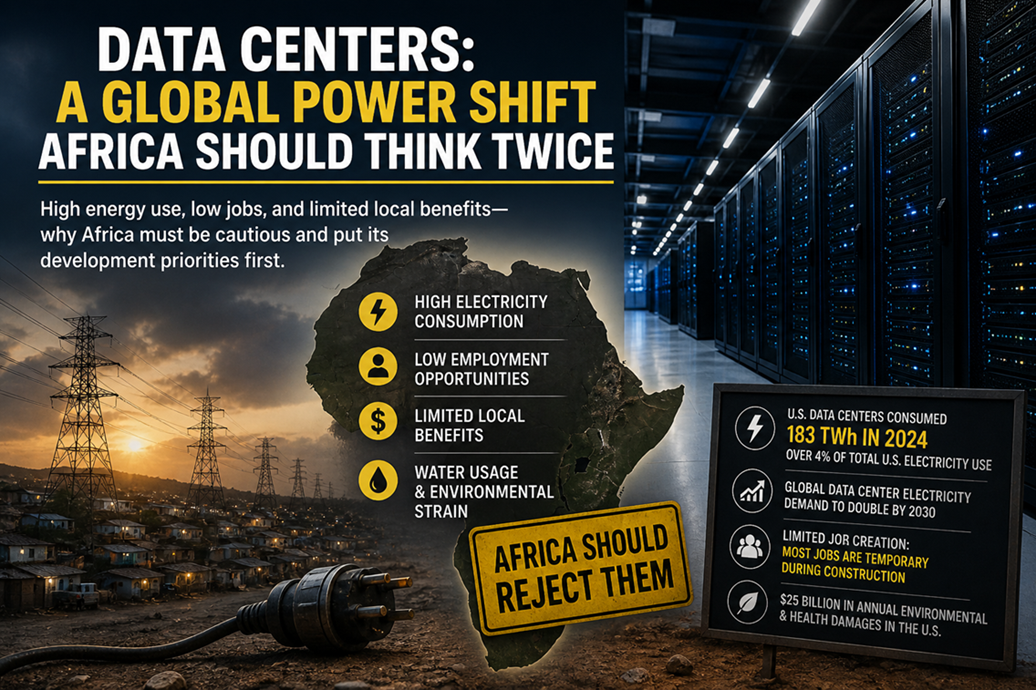
Image Credit: Image generated using AI for illustrative purposes.
Data centers are the invisible engines of the modern digital economy. Every email sent, video streamed, financial transaction processed, or artificial intelligence model trained depends on vast physical facilities filled with servers, storage systems, and networking equipment. Their rise has fundamentally reshaped how the world communicates, works, and innovates—but their rapid expansion also raises serious economic, environmental, and geopolitical questions, especially for developing regions such as Africa.
Why data centers are changing the world
At their core, data centers enable cloud computing, big data analytics, and artificial intelligence. These capabilities have transformed industries ranging from healthcare to finance. Governments rely on them for digital services, while businesses depend on them to scale globally. The explosive growth of AI has intensified this transformation: global investment in data center infrastructure exceeded $400 billion in 2025 and continues to rise sharply.
Their influence is also strategic. Countries now view data center infrastructure as critical to national security and economic competitiveness. Control over computing power increasingly translates into control over innovation, from defense systems to pharmaceutical research.
The hidden cost: massive energy consumption
Despite their benefits, data centers are extraordinarily energy-intensive. In the United States alone, they consumed about 183 terawatt-hours (TWh) of electricity in 2024—over 4% of total national consumption—and this figure could more than double by 2030.
To put this into perspective, that level of consumption is comparable to the entire electricity use of a mid-sized country. Individual facilities can consume as much power as 100,000 households, with some new hyperscale centers expected to use up to 20 times more.
The rapid expansion of AI is accelerating this trend. Electricity demand from data centers grew by 17% in 2025 alone and is projected to double globally by 2030.
This surge is already straining power systems. In states like Virginia, data centers consume a large share of total electricity supply, creating localized grid stress and requiring costly infrastructure upgrades.
Rising resistance in the United States
The U.S.—the global leader in data center deployment—is beginning to push back. Communities, policymakers, and researchers are raising concerns about rising electricity costs, environmental damage, and limited local benefits.
Recent reporting shows that expanding data centers are driving up electricity demand and contributing to higher consumer prices. Residents in some regions are effectively subsidizing infrastructure built to support private tech companies.
Environmental concerns are also mounting. A 2026 analysis estimated that U.S. data centers impose around $25 billion in environmental and health damages, largely due to pollution linked to energy consumption.
Critically, job creation—often used to justify incentives—is limited. Most employment occurs during construction, while operational facilities require relatively few workers. At the same time, they can distort labor markets; for example, high wages offered by data center projects have drawn skilled workers away from housing construction, delaying essential development.
This combination of high energy demand, rising costs, environmental impact, and limited employment is fueling political resistance across multiple states.
Could Africa host data centers?
Africa is increasingly discussed as a potential destination for future data center expansion. The continent offers advantages such as growing internet usage, proximity to emerging markets, and, in some regions, abundant renewable energy potential.
However, these theoretical benefits must be weighed against structural realities. Many African countries already face electricity shortages, unreliable grids, and limited generation capacity. Introducing highly energy-intensive infrastructure into such systems could exacerbate existing challenges.
Data centers require not only large amounts of electricity but also consistent, high-quality power—something many African grids struggle to provide. Diverting scarce energy resources to data centers risks crowding out households and essential industries.
Why data centers may not benefit Africa
Several structural issues suggest that hosting large-scale data centers may not deliver meaningful development benefits for Africa:
- Electricity burden
Data centers could significantly increase national energy demand in countries where supply is already insufficient. Given that some facilities consume as much electricity as entire towns, their presence could worsen power shortages or drive up costs for citizens. - Low employment impact
Unlike manufacturing or agriculture, data centers generate relatively few long-term jobs. Their highly automated nature means limited direct employment, reducing their value as a development strategy. - Capital outflow and foreign control
Most data centers are owned by multinational technology companies. Profits are often repatriated, limiting local economic gains. - Environmental strain
Beyond electricity, data centers require large volumes of water for cooling—sometimes millions of gallons per day—placing additional stress on already vulnerable ecosystems. - Infrastructure opportunity cost
Investments in grid expansion to support data centers could divert resources from critical sectors such as healthcare, manufacturing, or rural electrification.
Conclusion: a cautious path forward
Data centers are undeniably central to the modern digital economy and will continue to shape global innovation. However, the experience of the United States reveals a more complex reality: rising energy demand, environmental costs, limited employment, and increasing public resistance.
For Africa, the key question is not whether data centers are valuable globally, but whether they align with local development priorities. Given current energy constraints and economic structures, large-scale data center expansion risks imposing high costs while delivering limited benefits.
Rather than rushing to attract these facilities, African policymakers should prioritize energy access, industrial development, and digital infrastructure that directly benefits citizens. In many cases, that may mean resisting large-scale data center investments—at least until the continent can sustainably support them.
This is an opinion piece. The views expressed in this article are those of just the author.
Contact the author: contactauthor@africatechinsights.com
