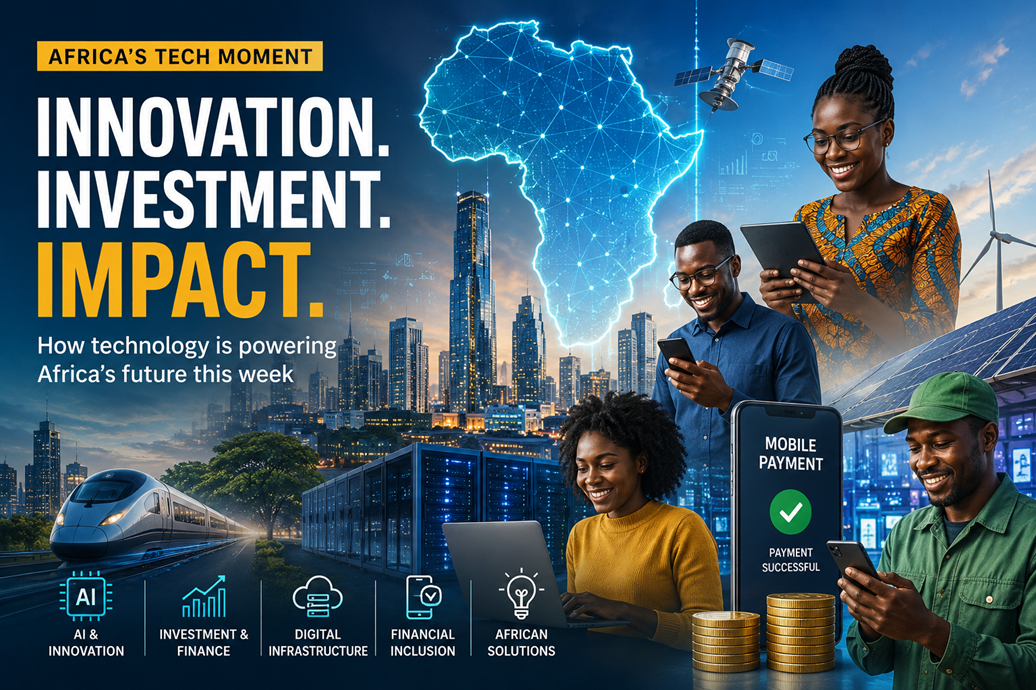
Technology Is Moving From the Phone Into the Economy
For years, Africa’s technology story was dominated by mobile money, fintech apps and consumer platforms. Those industries remain important, but this week showed that the next phase is broader.
Kenya’s Nairobi Securities Exchange announced plans for an AI-focused exchange-traded fund, expected before the end of 2026. The product would give Kenyan investors a local way to participate in the global AI economy rather than requiring them to send their money abroad.
This is significant beyond Kenya. It suggests that African financial markets are beginning to treat technology not simply as a sector for entrepreneurs, but as an investment category for ordinary investors and institutions.
That shift matters because Africa needs more domestic capital participating in its technology future.
East Africa’s Financial Technology Is Becoming Bigger
Another important development came from South Africa, where Nedbank is pursuing a major acquisition of Kenya’s NCBA. The proposed transaction would give Nedbank greater exposure to East African banking, infrastructure finance and fintech, including NCBA’s digital financial-services business Loop. The combined footprint would extend across Kenya, Tanzania, Rwanda and Uganda.
The bigger observation is that technology is increasingly being embedded inside traditional financial institutions.
Africa does not necessarily need to choose between banks and fintech companies. The next generation of financial services may come from the combination of both: banks providing scale, regulation and capital while technology provides speed, digital access and new products.
For small businesses and consumers, that could eventually mean easier payments, better access to financial services and more sophisticated digital tools.
Digital Infrastructure Is Becoming the Real Battleground
Africa’s AI ambitions will depend on something less glamorous than chatbots: data centres, cloud computing, connectivity and reliable electricity.
Recent investment across the continent shows that infrastructure is becoming a major technology story. Raxio, for example, has been expanding its African data-centre footprint, while connectivity providers are increasing access to major subsea cable networks.
This is critical because African businesses cannot build a competitive AI economy if every important digital service depends on infrastructure located somewhere else.
More local computing capacity can reduce latency, improve reliability and create opportunities for African developers to build services specifically for African markets.
The Opportunity Is Bigger Than AI
There is a temptation to view every technology story through the AI lens. Africa should resist that temptation.
The real opportunity is the infrastructure underneath AI: electricity, fibre, cloud platforms, payments, cybersecurity, data governance and skilled people.
Research published this year highlights the continent’s continuing AI infrastructure and accessibility gap, including relatively low internet penetration and a small share of global data-centre capacity.
That sounds like a weakness, but it is also an enormous opportunity.
Africa still has many digital systems to build. That means the continent does not have to simply replace old technology; in many sectors, it can leapfrog directly into newer systems.
My Observation: Africa Is Entering a More Serious Technology Era
The most encouraging development this week is not a single funding round or product launch. It is the direction of travel.
Technology is becoming connected to African capital markets, banking, infrastructure and national economic strategy. That is a much stronger foundation than a startup boom based only on popular apps.
The challenge now is execution. Africa must ensure that AI and digital infrastructure create African jobs, strengthen local companies, support entrepreneurs and remain accessible beyond the continent’s largest technology hubs.
If African governments, investors, universities and entrepreneurs get this right, the next decade could be very different from the last.
Africa should not only become a consumer of the next technology revolution. It has the opportunity to become one of its builders.
